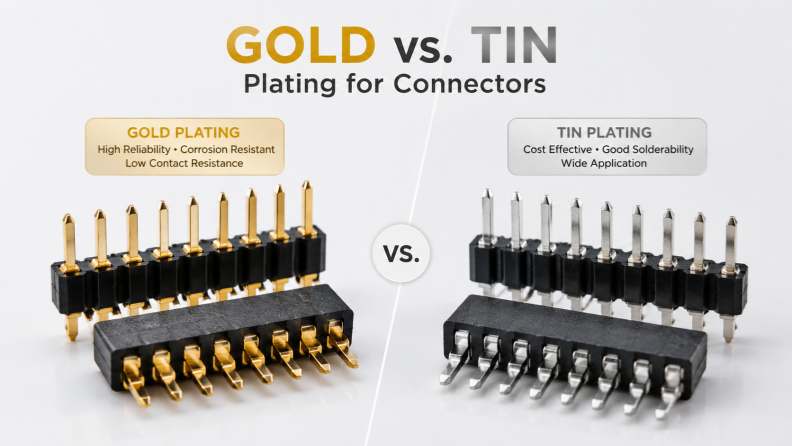
When selecting connectors for an electronic or electrical application, contact plating is an important factor that should not be overlooked.
Gold and tin are two of the most widely used plating materials for connector contacts. Gold generally provides better resistance to oxidation, fretting corrosion, and contact degradation, while tin offers a more economical solution for many applications.
So, which one should you choose?
The answer depends on the application, mating cycles, signal level, operating environment, reliability requirements, and cost target.
In this article, we compare gold and tin plating for connectors and explain when each option is the better choice.
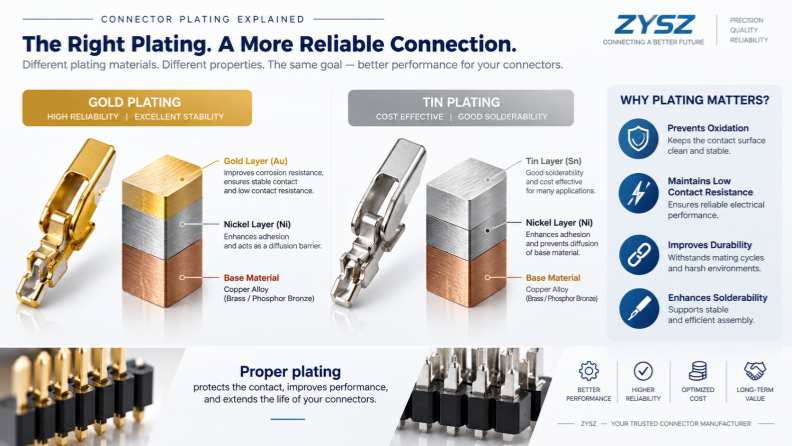
Connector contacts are typically made from copper alloys such as brass or phosphor bronze. While these materials provide good electrical conductivity and mechanical properties, their exposed surfaces can oxidize or deteriorate over time.
A suitable plating layer helps protect the contact surface and maintain reliable electrical and mechanical performance.
The choice of plating can affect:
Contact resistance
Corrosion resistance
Mating and unmating performance
Mating cycles
Signal reliability
Environmental durability
Manufacturing cost
Molex notes that the plating material, plating thickness, and operating temperature should be selected according to the application's mating-cycle and environmental requirements.
The basic difference is that gold is a noble metal, while tin is a non-noble metal.
Gold has excellent resistance to oxidation and corrosion, making it particularly suitable for reliable contact interfaces and low-level signals.
Tin is considerably less expensive and provides good solderability, making it widely used in cost-sensitive connector applications.
| Feature | Gold Plating | Tin Plating |
|---|---|---|
| Oxidation Resistance | Excellent | Moderate |
| Corrosion Resistance | Excellent | Good with proper design |
| Contact Stability | Excellent | Good |
| Mating Cycles | High | Generally lower |
| Low-Level Signals | Excellent | More challenging |
| Solderability | Good | Excellent |
| Cost | Higher | Lower |
| Typical Applications | Signal, data, high reliability | General-purpose, power, PCB |
| Environmental Resistance | Excellent | Application dependent |
The actual performance depends not only on the plating material but also on plating thickness, contact force, connector design, lubrication, and operating environment.
Gold plating is usually the preferred choice when long-term contact reliability is more important than minimizing connector cost.
Gold is particularly suitable for low-voltage and low-current signals where a stable contact interface is important.
This includes applications such as:
Data communication
Control signals
Sensors
Industrial electronics
Computer and networking equipment
Molex specifically identifies gold as a typical choice for high-reliability and low-level signal applications.
If a connector will be plugged and unplugged frequently, gold plating can provide better resistance to contact wear and fretting corrosion.
Typical examples include:
Board-to-board connectors
Test equipment
Industrial control equipment
Modular electronic systems
Replaceable modules
For these applications, the additional cost of gold plating may be justified by longer contact life.
Gold is highly resistant to oxidation and provides a stable contact surface in demanding environments.
For equipment exposed to:
Humidity
Industrial atmospheres
Temperature variation
Vibration
Long periods without mating
gold plating can provide an important reliability advantage.
Gold is not automatically the best solution for every connector.
For many applications, tin plating provides an excellent balance between performance and cost.
Cost-sensitive products
High-volume connectors
PCB connectors
Power connections
Fixed or infrequently mated connections
Applications where excellent solderability is required
Tin is particularly attractive when the connector does not require a large number of mating cycles.
For mass-production applications, the lower material cost of tin can make a significant difference to the overall connector cost. Molex also describes tin as a cost-effective option for designs with lower mating-cycle requirements.
It is important to understand that gold plating should not simply be selected because it is a more expensive or “higher-end” material.
The plating must match the application.
For example:
A low-cost connector used for a fixed PCB connection may not benefit enough from gold plating to justify the additional cost.
On the other hand:
A connector carrying low-level signals and subjected to frequent mating may require gold plating to achieve the desired reliability.
The right question is therefore not:
“Is gold better than tin?”
It is:
“Which plating is appropriate for this application?”
This is an important question for connector designers.
As a general design principle, gold-to-gold or tin-to-tin mating is preferred over gold-to-tin mating.
Mating dissimilar plating systems can introduce additional reliability concerns, including oxidation, fretting corrosion, and transfer of tin onto the gold contact surface. TE Connectivity has documented the potential for tin transfer and oxide formation in gold-to-tin mating systems.
Molex similarly recommends avoiding mixed gold-to-tin contact interfaces unless the specific system has been properly evaluated and tested.
Therefore, when designing a connector system, the plating of the mating contact and its counterpart should be considered together, rather than selecting each side independently.
A simple way to approach the decision is:
High reliability is required
The connector carries low-level signals
Frequent mating cycles are expected
The connector is exposed to humidity or harsh environments
Stable contact resistance is critical
Long service life is important
Cost is a major consideration
The connector is produced in high volume
Mating cycles are relatively low
The application is primarily power or general electrical connection
Good solderability is required
The connector is used in a controlled environment
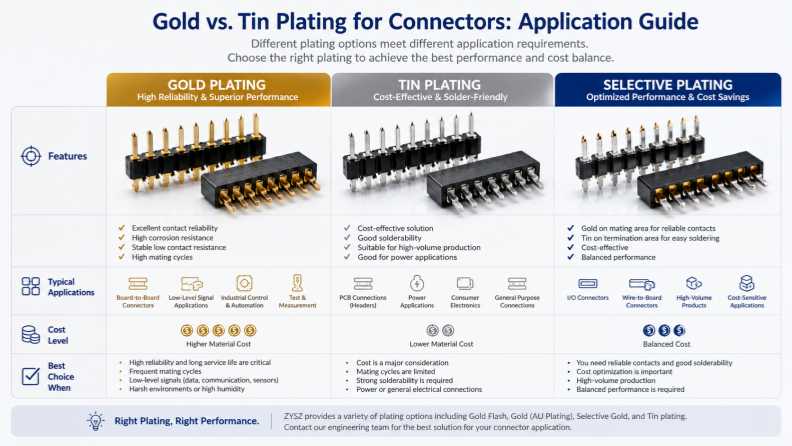
For many connectors, the entire contact does not necessarily need to be gold plated.
Selective plating can place gold only on the mating area while using a lower-cost finish on other portions of the terminal.
For example, a connector contact may use:
Gold on the mating area + Tin on the termination area
This approach can provide the required contact performance while controlling material cost.
TE Connectivity product families demonstrate this type of construction, with gold used on the mating area and tin used on the wire termination area.
This is particularly useful for high-volume connector applications where plating cost has a significant impact on the final product price.
There is no universal answer.
The right plating depends on several factors:
Application → Signal → Mating Cycles → Environment → Reliability → Cost
A simplified decision can be summarized as:
Low-level signal + frequent mating + high reliability → Gold
Cost-sensitive + low mating cycles + general electrical application → Tin
Mixed requirements → Consider selective plating
The plating thickness should then be selected according to the actual application requirements rather than simply choosing the thickest available gold layer.
Gold and tin plating both have important roles in connector manufacturing.
Gold plating offers excellent resistance to oxidation and contact degradation and is particularly suitable for high-reliability, low-level signal, and frequently mated applications.
Tin plating provides a cost-effective solution for many high-volume and general-purpose applications, particularly where mating cycles are limited and solderability is important.
The best connector plating is therefore not necessarily the most expensive one.
The best plating is the one that matches the application's electrical, mechanical, environmental, and cost requirements.
At ZYSZ, we can provide connectors with different contact plating options, including gold flash, gold plating, selective gold plating, and tin plating, according to application requirements.
If you are unsure which plating is suitable for your connector project, send us your drawing, specifications, or application requirements. Our engineering team can help evaluate the appropriate plating solution.
Contact: Steven
Phone: +86 18026591840
E-mail: biz@zyszindustry.com
Whatsapp:+86 13798308364
Add: B601/608, Building 4,Mingrenju Industrial Park,Shatian, Kengzi,Pingshan,Shenzhen, Guangdong, 518122